Wednesday, May 6, 2009

sage project :: sleeve corner


Finally, I got this right after an initial failed attempt. The photo above shows the knitted corner of a sleeve while the charting is shown to the left, the top chart being the normal square pattern and the lower one the amendment for making a "rounded" corner.

I've gone right back to traditional kimono designs for inspiration and these, as indicated by the diagram below, have a rounded shape to the sleeve bottom, something I've never seen in any kimono-style cardigan or wrap.

I am also knitting the pattern up from the sleeve bottom, not from the cuff or the shoulder as is usual. I don't, however, intend to make the sleeve quite as long as in the diagram. Sleeves with a very long drop are worn by unmarried maidens while a shorter drop is used by matrons and by men. So, since I'm a matronly person, the shorter drop is appropriate.

image downloaded from Hanami Web

celebrating mathematics

Sophia Kovalevskaya

Daily Celebrations on Mathematics To Become Happy:
If I feel unhappy, I do mathematics to become happy. If I am happy, I do mathematics to keep happy," ~ Alfréd Rényi

For over 5,000 years, civilization has practiced arithmetic, the working with numbers, with all of life's calculations steadfastly relying on the wonders of addition, subtraction, multiplication, and division.

"Wherever there is number," said ancient Athens mathematician Proclus, "there is beauty."

The beauty of mathematics has lived as long as man has. In ancient Egypt, math symbols found in the Rhind Papyrus (1650 B.C.) were described as "directions for knowing all dark things." The traditional system of 10 symbols with place values of hundreds, tens, and units was developed in India around 600 A.D.

"The object of mathematics is the honor of the human spirit," observed German mathematician Carl Jacobi.

Called the "gate and key to the sciences" by medieval scientist Roger Bacon, math provides the spirit with the endless joy of solving problems, experimenting, and discovery. From budgets to statistics to pie recipes, mathematics is an ongoing celebration of life!

"It is impossible to be a mathematician without being a poet in soul," said the eloquent Russian mathematician Sophia Kovalevskaya.

"Do not worry about your difficulties in mathematics, " said Albert Einstein. "I can assure you that mine are still greater."

~~Yeah: Let's hear it for Math!

Tuesday, April 28, 2009

country medley


ravelry notes

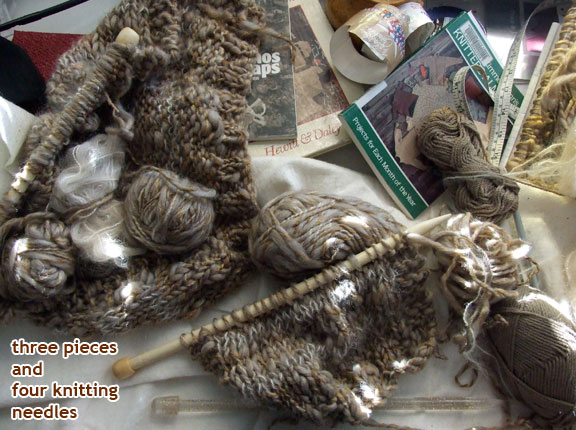
update 28apr: I’m knitting the three pieces (back and two fronts) on four 12mm needles (2 glitter, 2 bamboo) in this dappled morning light. Very inspired by Zimmermann. My clever techy son showed me how to add readable text to my photos.

uploaded 27apr:
This project started with 6 balls of Cleckheaton Country Spun purchased from psychoticspy. Despite the similar sounding name, it is not to be confused with Cleckheaton Nature Country Spun. I have them both and they are very different.

The 6 balls of this quite bulky yarn were not enough for a decent project on their own, so I’ve dug into my “ancient stash” (from Ms Nash from ten years ago). A couple of the things I’ve added do have labels but the Cleckheaton “Boutique Collection” seems to be long ago discontinued. The natural wool and the mohair have no labels so I’ve no idea what they are or where they came from.

I’m using 10mm and 12mm crafterschoice “glitter” needles purchased from Spotlight at 50c each. Silly as they are, I couldn’t resist them at that price.

Using the 10mm, I cast on 48 stitches for the back of what will be a cardigan vest (I think). Did 4 rows of k2p2 rib. Changed to 12mm and stst and did 4 rows of the Country Spun. Then 2 rows using the Boutique Collection combined with the mohair. Continuing to alternate 4 rows and 2 rows.

Decided to take photos while yarn is still inside labelled balls. The closeups show how these yarns are turning out.

I plan to use the natural wool and the orange alpaca combined to do a garter (or seed) stitch shoulder area and to finish the sleeve edges. I’ll just keep knitting fronts and back until the yarn runs out, then switch to these to finish.

I’m very happy with the effect so far. The cat, especially, loves it and my son likes the feel of it so might want it for himself. I make all my cardigans to a man’s button-holing as I don’t mind it that way and it keeps it unisex.

Monday, April 27, 2009

wholemeal scones


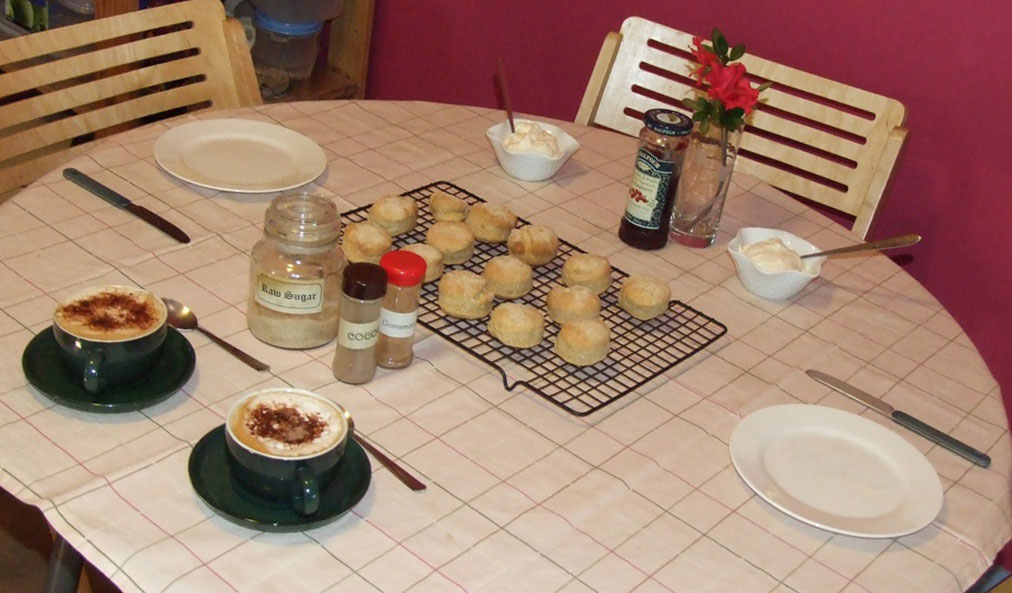
Theo made these cute wholemeal scones, laid out the table nicely, whipped up some cream, and made the cappuccinos. What more could I want in a son?

Saturday, April 25, 2009

sage project :: Artemis revealed

multi-breasted (Greek) Artemis or
(Roman) Diana of Ephesus
Compare all of those dangling boobs on the goddess above with some lace knitting I recently completed.


Maybe the photos don't do it justice, but this goddess is what immediately came to my mind when I looked at this swatch. Below, the swatch has been ironed flat and looks how it is intended to look.


The stitch pattern comes from a vintage pattern called "Laurel Sleeveless Blouse and Skirt", shown below.


I will be knitting up this lovely sage-coloured wool using this stitch pattern though not the blouse and skirt pattern. I hope to work out a design inspired (at least vaguely) by Japanese kimonos, like this one:


Utagawa Kuniyoshi
Japanese, 1798 - 1861
Sweet Briar College Art Gallery

Thursday, April 23, 2009

star hat


ravelry notes

I like the star stitch in the “Fantasy” vintage crochet shawl, nicely illustrated in k2p2me2’s version. However, I don’t need another shawl or scarf. Instead, I needed a light autumn hat, preferably using my new “$2 shop” cotton.

I was also inspired by greenopaldream’s “How to fill in some time Coronet style beanie”. A simple and pretty way to showcase a traditional stitch pattern. And neat improvisation.

I decided to go for a partial beret shaping, not too wide or floppy but enough to “house” my pony tail. It is part knit, part crochet.

CO 120 sts with recommended needle size (3.25mm).
k1p1 rib for an inch.
BO knitwise (not in rib) and keep last loop to begin crochet.
Started with mesh row of the Fantasy star stitch pattern, making 60 holes. Then a row of stars. Then a row of mesh with alternating V-stitch to increase holes to 90. Then a few rows straight.
Starting separately, I made a small crochet chain circle into which I put 11 of the mesh holes. Then a row of stars, then doubled the mesh holes using all V-stitch. Then stars again. Then alternating V-stitch on the mesh row. And so on until I had 88 holes. I added 2 more V-stitches on the last row to bring the count in line with the base.
Then held the two bits together and did a double crochet into each pair of holes, then a chain, then a dc into next pair of holes, and so on.

It’s pretty simple and it’s just what I needed in a hat right now. :)

knitting needle organizers


ravelry notes

Each of these 3 organizers is made using scrap yarn and packaging waste.

1) flat holder with needle size list: This started with a plastic bag that originally packaged a shower curtain. Using a hole punch I made holes in positions for inserting and securing needles. The backing is a piece of A4 size cardboard (again salvaged from packaging) with a nice scrapbook sheet in front and the list of needle sizes stuck onto that. The whole is hung on a crochet chain of white soya yarn, hung in turn from a picture hanger.

2) needle ball: This started from a strong cardboard cylinder around which some Sirdar cotton had been wound. I covered it in a garter stitch band of chunky scrap yarn and tied the yarn across at top and bottom to secure it. Lighter and finer needles are thread into the yarn and are quite happy to sit there securely. Another double strand of scrap yarn is attached and looped over some of the longer needles in the flat organizer.

3) dpn column: This started from a cardboard cylinder that had held kitchen paper. At a recent closing down sale at Spotlight, I obtained eleven sets of Birch “double ended” (or double pointed) needles, ranging in size from 2mm to 7mm. The smaller six of these are attached to this cylinder (and the larger five will find a home next time I run out of kitchen paper). I used scissors to round out the edges and cut the label down to size only (no need to keep advertising Birch). Carefully, with a Stanley knife, I cut out the top of the plastic housing so I can now easily remove needles and replace them in this original packaging. The 20cm needle packaging is just right for the kitchen paper cylinder (itself 20cm long) so as to allow a staple at top and at bottom. A decorative knitted collar has been added. This dpn column must stand upright. All the needles fall out if tipped upside-down. However, this is a small price to pay for having them so well organized and so accessible.